Informing emission inventories using observations
Methods for reporting national GHG emissions to the UNFCCC are based on emission factors and activity data. However, these methods have uncertainties especially for non-CO2 GHGs, and for CO2 emissions and removals from LULUCF. Thus, independent verification of the emissions needs to be provided.
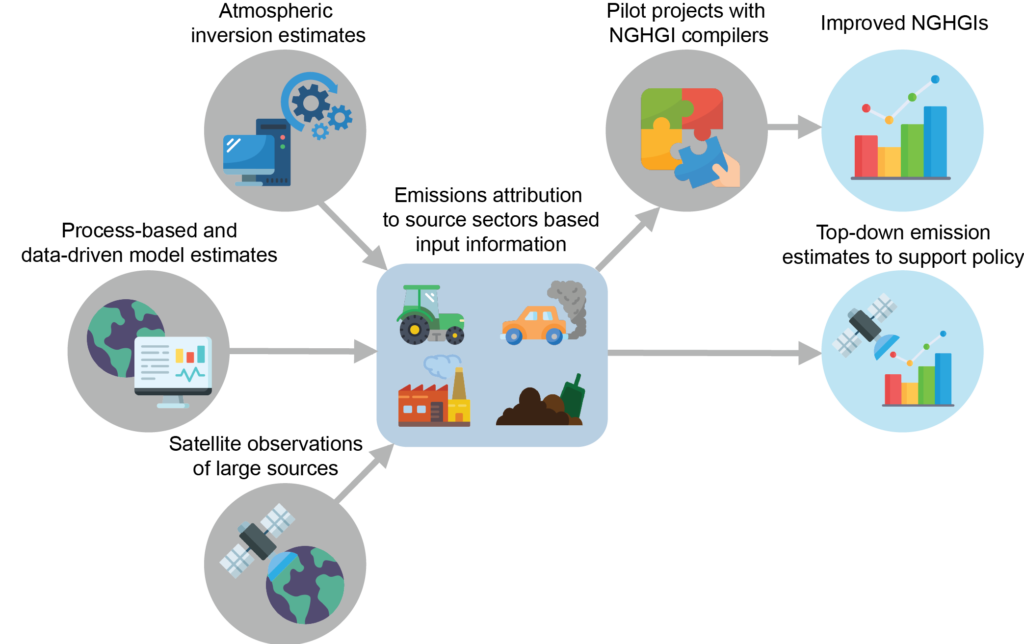
EYE-CLIMA will rigorously examine how atmospheric-inversion based flux estimates can be used to support national emission inventories. Although atmospheric inversions provide a mass balance constraint on the fluxes, they generally cannot provide a strong constraint on the source type, which is needed to provide useful information on emission inventories. Therefore, EYE-CLIMA will focus on the attribution of the fluxes from inversions to source types by analysing the spatiotemporal patterns of the fluxes and through using auxiliary information from e.g. process-based modelling. For CH4, some constraint by source type is possible by including its stable isotopes (e.g. δ13C) in atmospheric inversions.
EYE-CLIMA will work together in pilot projects with three agencies who compile national emission inventories to develop a prototype methodology to compare atmospheric inversion fluxes with inventories. This will form the basis of a guideline on how to attribute atmospheric inversion fluxes to sectors and how these can be used to support and verify inventories.